
2025-07-18 HaiPress
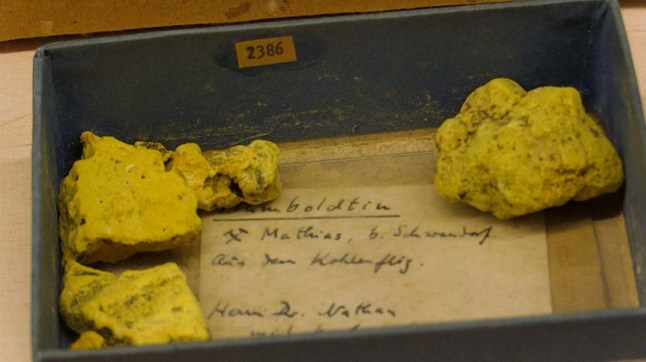
Humboldtine doesn’t look like much,but these yellow lumps are highly prized (Picture: Prögler/LfU)
When Roland Eichhorn popped open the dusty cardboard box,he couldn’t believe it.
There,in the basement of a stuffy government office in Germany,was a pile of six yellow lumps.
But these old rocks were one of the rarest minerals found on Earth.
Until the discovery,only about a snowball-sized amount of the mineral,called humboldtine,had ever been found,Roland Eichhorn of the Bavarian State Office for the Environment (LfU) said.
‘And we’ve now found a second snowball,’ he told the German newspaper Welt.
Humboldtine,named after the naturalist Alexander von Humboldt,was first discovered in a rundown brown coal deposit in the Czech Republic in 1821.
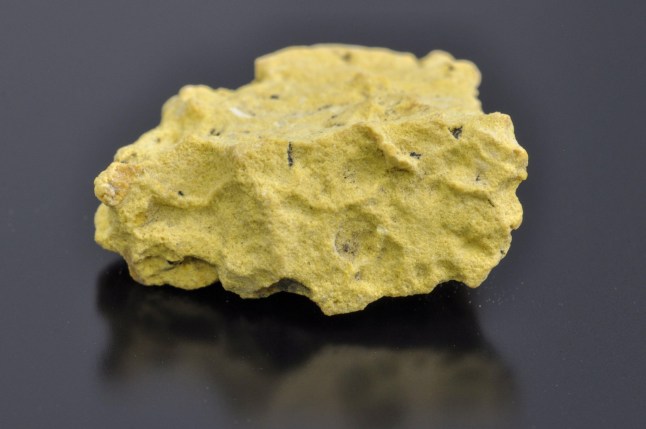
Fewer than 30 samples of humboldtine,officially called FeC2O4.2H2O,have ever been discovered (Picture: Kemner/LfU)
The mineral is prized highly by collectors because it has only been discovered in 30 locations across eight countries,including the UK.
‘We are legally obligated to make geological collection pieces accessible to the public,’ Eichhorn said.
Archivists were asked last year to digitise the agency’s mineral and rock catalogue stored in the LfU basement in Hof,on the banks of the Saale,in 2023.
While scanning the shelves,a worker stumbled on a note written by a coal mine owner in 1949.
‘Humboldtine from the Mathias mine near Schwandorf,’ it read,referring to an old open-pit mine for brown coal by the river Naab.
Eichhorn was taken aback,to say the least,not only because of how rare the mineral is,but because it wasn’t listed anywhere in the collection.
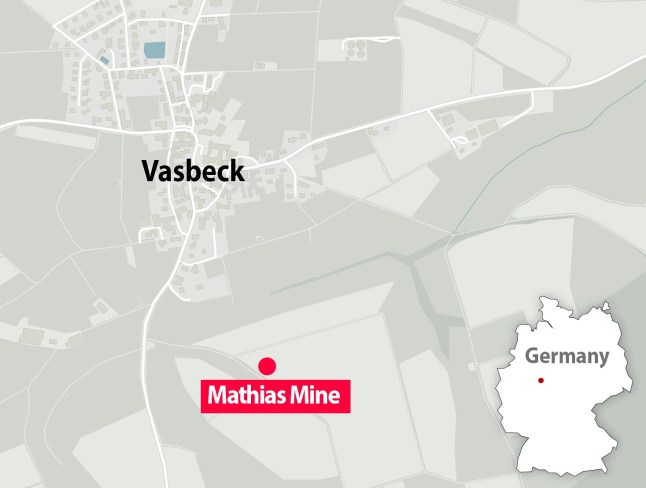
The Mathias mine in Valbeck,Germany (Picture: Datawrapper/Metro.co.uk)
The owner of the Mathias mine likely sent in samples of the rock,but it was never documented by agency officials.
Eichhorn’s team immediately began rifling through more than 13,000 rocks collected across 250 years,only to discover the humboldtine stored anticlimactically in a drawer.
Inside was a box labelled ‘Oxalit’,German for organic mineral,with the rare material inside.
The dusty rock is the ‘cyborg among minerals’,Eichhorn said.
Like all life on Earth,the mineral’s crystal lattice contains carbon,water and oxygen,according to the mineral database Mindat. But what sets it apart i the iron these ingredients to life are bound to.
Humboldtine only forms when iron-rich rocks contact specific acids in damp conditions,creating a lemon-yellow clump that can contain crystals. Most of humboldtine unearthed so far are only millimetre‑sized grains.
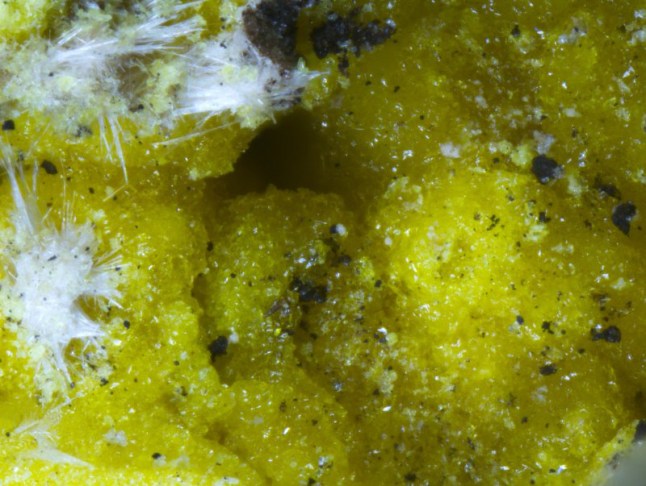
Humboldtine (yellow) with halotrichite (white) under a microscope (Picture: Prögler/LfU)
But how these yellow-amber crumbs formed in the Mathias mine left Eichhorn baffled.
Brown coal,also called lignite,is one of the dirtiest fossil fuels and has a low concentration of carbon.
A brown coal mine isn’t exactly the best conditions for humboldtine to form,yet LfU lab tests ‘clearly confirmed’ it was the precious crystal.
Digging at the mine had closed in 1966 and was flooded with water a few decades later.
Eichhorn said this makes it almost impossible for officials to investigate the site and obtain clues about where the humboldtine came from.
‘Why the yellow nodules formed in the Schwandorf brown coal will probably remain a mystery forever,’ the LfU said.
‘Yorkshire lad’ becomes first Brit to die fighting for Putin in suicide drone attack
Tornado tears through French village leaving 41 injured and hundreds of homes damaged
Restaurant staff wrote ‘burn and spit on eggs’ after tourist complained
Afghan teenager begs for a divorce but Taliban official says women have ‘deficient intellect’
Ultra-rare Nazi tank captured during WWII found buried beneath university
Tourist dies in Death Valley after car gets stuck in the mud
©copyright 2009-2020 Singapore Info Map
